

€ 35,00
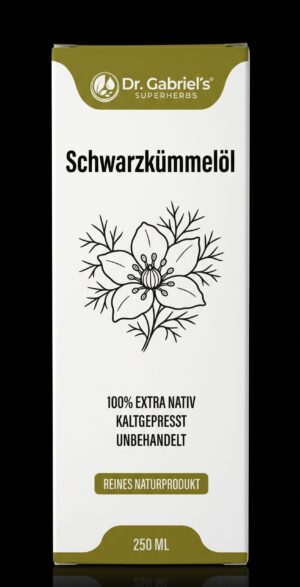
Dr Gabriel’s® Black Seed Oil is cold-pressed and extra virgin — the highest quality classification for Nigella sativa oil. Every bottle is produced directly in our own facility in Mostar, Bosnia & Herzegovina: from raw seed to finished product, under full quality control and certified laboratory analysis.
Nigella sativa has been treasured for centuries in traditional wellness practices across the Middle East, Central Asia and the Mediterranean. Rich in thymoquinone, essential fatty acids (Omega-3 & Omega-6), and natural vitamins (B1, B2, B9), it is one of the most studied botanical oils in modern phytotherapy — with over 200 published scientific studies.
Vegan · GMO-free · No additives · 250ml · 60-day money-back guarantee.
⚠️ Disclaimer: This product is a food supplement and not a substitute for a varied diet and a healthy lifestyle.
Black Seed Oil (Nigella sativa) is one of the most historically celebrated botanical oils in the world. Referenced in ancient Egyptian texts, mentioned in Hadith — the recorded traditions of the Prophet Muhammad — and documented across centuries of use from the Middle East to Central Asia and the Mediterranean, Nigella sativa has earned a singular place in the history of traditional plant medicine.
Dr Gabriel’s® brings this ancient botanical to the modern AT/DE health supplement market in the form of a premium cold-pressed extra virgin oil. From raw seed to sealed bottle, every step is carried out under direct quality oversight and independent laboratory verification. This is not a commodity oil — it is a traceable, artisan-quality product with full chain-of-custody from source to shelf.
Not all black seed oils are equal. The quality classification of Nigella sativa oil depends critically on how it is processed:
Dr Gabriel’s® Black Seed Oil meets all three criteria — cold-pressed, extra virgin, unrefined. This is the oil in its most biologically complete and nutritionally intact form.
| Component | Value / Content | Notes |
| Total fat content | 99.41% | Predominantly beneficial unsaturated fats |
| Omega-6 linoleic acid (LA) | ~55–65% | Dominant fatty acid — essential, not synthesised by body |
| Omega-9 oleic acid | ~20–25% | Monounsaturated — cardiovascular support |
| Omega-3 alpha-linolenic acid | ~0.5–2% | Essential fatty acid |
| Thymoquinone (TQ) | Key active compound | Primary bioactive — antioxidant, studied extensively |
| Free fatty acids | 6.7% | Within acceptable range for cold-pressed oils |
| Peroxide value | 15.36 mmal O₂/kg | Laboratory verified — freshness indicator |
| Refractive index | 1.4720 | Standard for authentic Nigella sativa oil |
| Vitamin B1 (Thiamine) | Naturally present | Contributes to normal energy metabolism |
| Vitamin B2 (Riboflavin) | Naturally present | Contributes to normal energy metabolism |
| Vitamin B9 (Folate) | Naturally present | Contributes to normal amino acid synthesis |
The following functional statements are consistent with EU Regulation 1924/2006, traditional use evidence frameworks, and the body of published scientific literature on Nigella sativa and its key constituents:
| Group | Daily Dose | Timing | Duration / Notes |
| Adults — initial month | 1 tbsp (15ml) × 3/day | Before or with meals | High-intensity phase — first 30 days |
| Adults — maintenance | 1 tbsp (15ml) × 1/day | Morning, before breakfast | Long-term daily use recommended |
| Children (6–12 yrs) | 1 tsp (5ml) × 2/day | With meals | Consult paediatrician under age 6 |
| Children (under 6) | Consult paediatrician | — | Do not use without medical guidance |
| Pregnant / breastfeeding | Do not use | — | Contraindicated — see warnings |
| Transplant patients | Do not use | — | Contraindicated — see warnings |
Shake well before each use. The characteristic strong aroma and taste of Nigella sativa is natural and indicates an unrefined, additive-free product. A lemon- and orange-flavoured variant is also available for those who prefer a milder taste profile.
Once opened: use within 3 months. Store in a cool, dark place away from direct sunlight. Keep refrigerated after opening for optimal freshness.
Black Seed Oil (Nigella sativa) is a traditional botanical oil used for centuries across the Middle East, Central Asia and the Mediterranean for general wellbeing, immune support and digestive comfort. Modern research has focused on thymoquinone — its primary active compound — in relation to antioxidant and anti-inflammatory properties. It is consumed as a daily food supplement, typically 1 tablespoon before meals.
Cold-pressed means no heat is used during oil extraction — preserving thymoquinone, essential fatty acids and heat-sensitive nutrients. Extra virgin indicates first-press oil of the highest purity and lowest free fatty acid content. Together, these terms identify an unrefined, additive-free oil in its most nutritionally complete form — unlike refined or solvent-extracted black seed oils.
The standard adult protocol is 1 tablespoon (15ml) taken 1–3 times daily before or with meals. Nigella sativa oil has a characteristically strong, slightly bitter and spicy taste due to its natural thymoquinone content — this is a sign of an authentic, unrefined oil. For those who find the taste intense, Dr Gabriel’s® also offers a lemon and orange flavoured variant. Always shake well before use.
Yes. Dr Gabriel’s® Black Seed Oil is produced entirely in our own cold-pressing facility in Mostar, Bosnia & Herzegovina — from raw seed sourcing to bottling. The oil undergoes independent quality analysis by the Federalni Agromediteranski Zavod Mostar (Analytical Report 134/11). Most black seed oils sold in Europe are imported as bulk oil and repackaged — ours is manufactured from scratch in-house.
Black Seed Oil is not suitable for: pregnant or breastfeeding women; individuals who have received organ transplants; people with autoimmune conditions; individuals with a known allergy to Nigella sativa or related plants. If you take prescription medications — particularly blood thinners or immunosuppressants — consult a healthcare professional before use. Not recommended for children under 6 years of age without paediatric guidance.
| Health Goal | |
|---|---|
| Product Form | |
| Pack Size | |
| Target Group | |
| Vegan Certified | |
| GMO-Free | |
| Made In | |
| Quality & Certifications | 60-Day Money-Back Guarantee, Cold-Pressed, No Artificial Additives |
| Daily Dose | 1 tbsp Oil |
| Key Active Ingredient |
Reviews
There are no reviews yet.